The Essential Knife Skills Every Home Cook Should Master

A sharp knife in capable hands transforms cooking from a chore into a craft. This post covers the fundamental knife skills every home cook needs—proper grip, basic cuts, and blade maintenance—plus the small details that separate clumsy chopping from confident, efficient prep work. Master these techniques and you'll prep faster, cook more evenly, and keep your fingers intact.
What's the Proper Way to Hold a Chef's Knife?
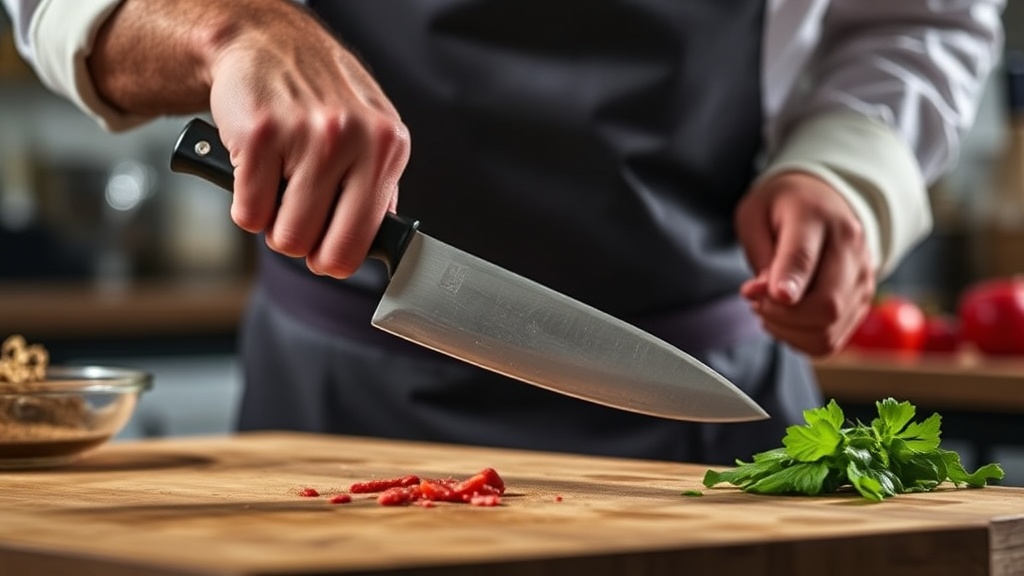
The pinch grip is the foundation of safe, precise cutting. Grip the blade between your thumb and index finger just above the handle, then wrap your remaining three fingers around the handle itself. This gives you control over the blade's balance point—reducing strain and improving accuracy.
Most beginners grip the handle like a hammer. That's natural, sure. But it pushes the pivot point too far back, making the tip feel heavy and unwieldy. With the pinch grip, the knife becomes an extension of your hand. The Wüsthof Classic 8" Chef's Knife and the Victorinox Fibrox Pro 8" both have balanced bolsters designed specifically for this technique.
Your other hand—the guiding hand—curls fingertips inward, forming a claw. The knuckles rest against the flat side of the blade, acting as a physical guide. The fingertips stay tucked safely behind. Practice this motion slowly: knife tip stays on the board, heel lifts and rocks down through the food. The motion comes from the shoulder, not the wrist.
What Are the Basic Knife Cuts Every Cook Should Know?
Professional kitchens use standardized cuts for consistency—food that cooks evenly and looks appealing. You don't need to dice a perfect brunoise at home, but understanding these five foundational cuts will improve every dish you make.
Julienne
Thin matchstick strips, about 1/8 inch square and 2-3 inches long. Think French fries before frying, or the crisp vegetables in Vietnamese goi cuon. Start by squaring off your vegetable—remove rounded edges so you have a stable rectangular block. Slice into 1/8-inch planks, stack those planks, then slice again into strips.
Batonnet
The larger cousin to julienne—1/4 inch square, 2-3 inches long. These are your standard crudité sticks. That said, they're also the starting point for medium dice (more on that shortly).
Dice: Small, Medium, and Large
Dicing creates uniform cubes. The size matters—small dice cooks faster than large dice, so mixing them in the same recipe creates uneven textures.
| Cut Name | Dimensions | Best For |
|---|---|---|
| Small dice (macédoine) | 1/4 inch | Salsas, stuffings, fine sauces |
| Medium dice (parmentier) | 1/2 inch | Stews, soups, roasted vegetables |
| Large dice (carré) | 3/4 inch | Stock vegetables, rustic dishes |
Chiffonade
Leafy ribbons. Stack basil, spinach, or mint leaves, roll them into a tight cigar, then slice crosswise. Fresh basil cut this way won't bruise or blacken the way chopped basil does. The technique works beautifully for garnishing pasta or finishing soups.
Mince
The finest cut—think garlic, shallots, or herbs. Rock the knife through the ingredient repeatedly, occasionally scraping the pile back together. Some cooks sprinkle coarse salt over garlic before mincing; the salt acts as an abrasive, breaking down the cell walls faster. (Don't forget to adjust your recipe's salt accordingly.)
How Do You Keep Knives Sharp?
A dull knife is dangerous—period. It requires more force, slips easily, and causes worse injuries than a sharp blade. Honing and sharpening are different processes, and you need both.
Honing realigns the microscopic teeth on your blade's edge. Use a honing steel weekly—yes, even that rod that came with your knife block. Hold the steel vertically, tip resting on a cutting board. Draw the knife down at a 15-20 degree angle, alternating sides. The sound should be smooth, not scratchy. The ZWILLING Twin Sharpening Steel is a solid mid-range option.
Sharpening actually removes metal to create a new edge. Here's the thing: most home cooks don't sharpen often enough. Once every few months is typical for regular use. You have three options:
- Whetstones—The gold standard. Soak coarse (1000 grit) and fine (6000 grit) stones in water for 15 minutes, then work the blade across at a consistent angle. Learning curve is steep, but results are unmatched.
- Pull-through sharpeners—Convenient, affordable, and easier to use correctly. The Work Sharp Culinary E2 sharpens at the proper angle automatically. Worth noting: aggressive sharpeners can shorten blade life over decades of use.
- Professional sharpening services—Mail-in or local services restore badly damaged edges. Expect to pay $5-10 per knife. In Fredericton, several kitchen supply stores offer seasonal sharpening clinics.
The catch? Ceramic "sharpeners" don't sharpen at all—they're actually honing rods made from harder material. Useful, but not a replacement for actual sharpening.
Which Cutting Board Protects Your Blades?
Your board matters as much as your knife. Glass and marble boards destroy edges within weeks. Hard plastics are better but still cause premature dulling. End-grain wood and soft rubber are the sweet spots.
End-grain wood—the kind where you see the tree rings facing up—allows knife edges to slip between wood fibers rather than chopping across them. The John Boos Reversible Maple Cutting Board has served commercial and home kitchens for decades. It requires maintenance: monthly mineral oil conditioning (food-grade, not vegetable oil which goes rancid) and occasional beeswax for sealing.
Soft rubber boards—like those from Asahi or Hasegawa—offer the best of both worlds. They're gentler on edges than wood, dishwasher safe, and non-porous enough for raw meat prep. The textured surface grips food without slipping. Downside? They're pricier than wood and can scar deeply if you really hack at them.
That said, if you own just one board, make it a large wooden one (at least 15x20 inches). Small boards crowd your workspace and force unsafe cutting angles.
Washing and Storage
Never put quality knives in the dishwasher. The heat, detergent, and jostling dull edges and loosen handles. Hand wash immediately after use, dry thoroughly, and store properly.
Magnetic strips keep edges protected and accessible—unlike knife blocks where blades rattle against wood or (worse) slide against each other. In-drawer trays work if counter space is limited, but ensure slots are wide enough that blades don't scrape.
When Should You Use a Serrated Knife vs. a Chef's Knife?
The chef's knife handles 90% of kitchen tasks, but that remaining 10% matters. Serrated blades excel at foods with hard exteriors and soft interiors—crusty bread, ripe tomatoes, citrus. The teeth bite through surfaces that would squash or tear under a straight edge.
Boning knives feature narrow, flexible blades that curve around joints and slide under silver skin. A stiff boning knife works better for beef and pork; flexible blades suit fish and poultry. The Global GF-31 has a loyal following, though the Mercer Culinary Genesis offers comparable performance at half the price.
Parers handle detail work—peeling apples, deveining shrimp, hulling strawberries. If you find yourself switching knives constantly, your chef's knife probably needs sharpening. A sharp 8-inch blade can accomplish surprisingly delicate tasks.
The Rocking Motion
European-style chef's knives (Wüsthof, Zwilling, Messermeister) have pronounced curves designed for rocking—tip stays planted, heel moves up and down. This is fast and efficient for mincing herbs or dicing onions.
Japanese gyutos (Shun, Miyabi, Mac) have flatter profiles optimized for push-cutting—slicing straight down with minimal horizontal movement. This style excels at precise vegetable work and creates cleaner cuts on delicate proteins.
Most home cooks develop a hybrid style. That's fine. The key is staying consistent within each cutting session—switching between rocking and push-cutting mid-recipe creates uneven results.
Safety Habits
Sharp knives are safe knives. So are dry cutting boards—wipe moisture before starting. Never try to catch a falling blade. Step back, let it drop, replace it if damaged.
When scraping ingredients from board to bowl, flip the knife and use the spine. The edge is for cutting only—scraping rolls the microscopic teeth, creating a wire edge that dulls quickly and cuts unpredictably.
A towel under your board prevents slipping. A damp paper towel works in a pinch. Speaking of towels—keep one handy for drying hands. Wet hands plus sharp knives equal emergency room visits.
Practice these fundamentals slowly. Speed comes naturally; precision requires intention. The home cook who dices one perfect onion slowly will eventually dice faster than the one who rushes through ten sloppy ones. Your knife is your most-used kitchen tool—respect the blade, maintain the edge, and the work becomes genuinely satisfying.